Height does not decide how much light you have: it decides how that light is spread. Inside a tent with reflective walls almost every photon ends up on the crop, so raising the fixture 20 cm does not take light away — it takes away the hot spot.
As a starting point with a bar-style fixture: 60–75 cm for cuttings and seedlings, 40–60 cm in vegetative growth and 30–45 cm in flower. But those centimetres only apply to the fixture they were measured with: the right height is the one that keeps PPFD inside the range the stage asks for.
Why centimetre tables get it wrong
Search for “how high to hang my LED” and you get tables with round numbers: 60 cm in veg, 40 in flower. The problem is that those centimetres never say which fixture they are talking about. A 120 W panel and a 1,000 W panel at the same height have nothing in common: the first falls short and the second burns.
Height is not an input, it is the consequence of two inputs: the PPF your fixture delivers and the square metres you want to cover. With those two numbers the height follows; without them, any figure is borrowed from somebody else’s panel.
You do not pick the height, you solve for it
Fix the PPFD the stage asks for, look at your fixture’s PPF and your area, then raise or lower until the point under the fixture lands inside that range. The tape measure is the tool, not the answer.
What raising the fixture actually changes
Here is the part almost nobody mentions, and it changes how you set a room up. In a tent with reflective walls the photons that leave sideways are not lost: they bounce and land back on the crop. Which means the average PPFD over the area is practically the same at 30 cm as at 60 cm. What changes is the distribution.
- Fixture low: a lot of light directly underneath and very little in the corners. The plants in the middle run ahead, the ones on the outside lag. In extreme cases, burnt tips and tacoing leaves in the centre while the rest coast along.
- Fixture high: even spread, every plant in the same range, far less risk of burning. In exchange you lose usable growing height and, if the tent is not reflective, you really do lose light through the walls.
Put another way: lowering the fixture does not give you more light, it gives you more inequality. And you pay for inequality in the corners, which is where half your plants are.
Drag the slider and watch what happens to the centre and to the average. If the centre figure jumps and the average barely moves, you have the mechanism:
Height by stage, and what really happens in each one
With the mechanism clear, the ranges make sense. They are not rules: they are where PPFD usually lands inside what the plant asks for, with a mid-range bar fixture.
Light by growth stage
Reference values
| Stage | PPFD | Photoperiod | DLI | What for |
|---|---|---|---|---|
| Cuttings and seedlings | 100 – 300 | 18 h | 13.0 | Rooting and establishment without stressing the leaf |
| Vegetative growth | 300 – 600 | 18 h | 29.2 | Structure, short internodes and broad leaf |
| Flowering without CO₂ | 600 – 900 | 12 h | 32.4 | Production: the range that decides the harvest |
| Flowering with CO₂ | 900 – 1,200 | 12 h | 43.2 | Only worth it with enrichment and controlled climate |
PPFD in µmol/m²/s and DLI in mol/m²/day. Switch the photoperiod with the buttons to see how DLI moves at the same intensity.
For cuttings and seedlings you work high on purpose. The plant has little root and cannot sustain high transpiration; 100–300 µmol/m²/s is plenty and anything extra shows up as stress before it shows up as growth.
In vegetative growth height works as a shape control. Closer, the plant compacts and internodes shorten; further away, it stretches. If you want a short, wide plant, lowering the fixture is cheaper than pruning.
In flower height matters most, because that is the stage that decides the yield and the only one where you can no longer touch the photoperiod. The goal here is 600–900 µmol/m²/s over as much of the area as possible, not 1,200 in the middle and 400 in the corners.
Setting the height without a PAR meter
The right way is to measure with a PAR sensor. If you do not have one, there are three ways to get close:
- Work it out. Average PPFD = fixture PPF ÷ square metres. If that already sits in the stage’s range, your problem is not height, it is spread — and you fix it by raising until the centre stops spiking.
- Read the plant, not the tape. Tacoing leaves (edges curling up into a canoe) and bleached tips on the plants in the middle while the rest look normal is localised over-intensity: raise it. Long internodes and plants reaching for the light: lower it.
- Start high and come down. Dropping 5 cm every two or three days and watching is slow, but it has no expensive way back. Raising the fixture after you have burnt the tops does.
The mistake of dimming to 50 % instead of raising the fixture
They are two different things. Dimming drops PPFD evenly across the whole area and saves you electricity. Raising the fixture spreads the same total better. If your centre is burnt and your corners are weak, dimming makes the corners worse; what you need is height.
When the problem is not the height
There are three situations where moving the fixture fixes nothing, and it is worth spotting them before you spend a week pulling on ratchet hangers.
- You do not have enough fixture. If PPF divided by square metres already lands below the range you are after, no height fixes that. You need more µmol/s, not more rope.
- You have too much fixture. A very large panel in a small tent forces you so high that you run out of growing height. Getting the size right is cleaner than compensating with distance.
- One point source over a large area. Beyond roughly 2 m², a single central fixture will always leave the corners poor however high you hang it. Two units spread better than one of twice the power.
If you suspect you are in one of the three, the sum takes ten seconds with your own measurements:
Mounting details that do matter
- Level it. A fixture 3 cm out of level end to end spreads noticeably worse. Two-rope ratchet hangers drift easily: check with a level, not by eye.
- Keep it off the wall. A fixture pushed into a corner sends half its light into the fabric. Centred, the reflection works for you.
- Leave air above it. Passively cooled fixtures rely on convection; pressing them against the tent roof raises heatsink temperature and shortens diode life.
- Hang on ratchets, not zip ties. Not for comfort: so you can correct 5 cm in thirty seconds instead of taking the whole thing down.
The fixtures these figures are based on
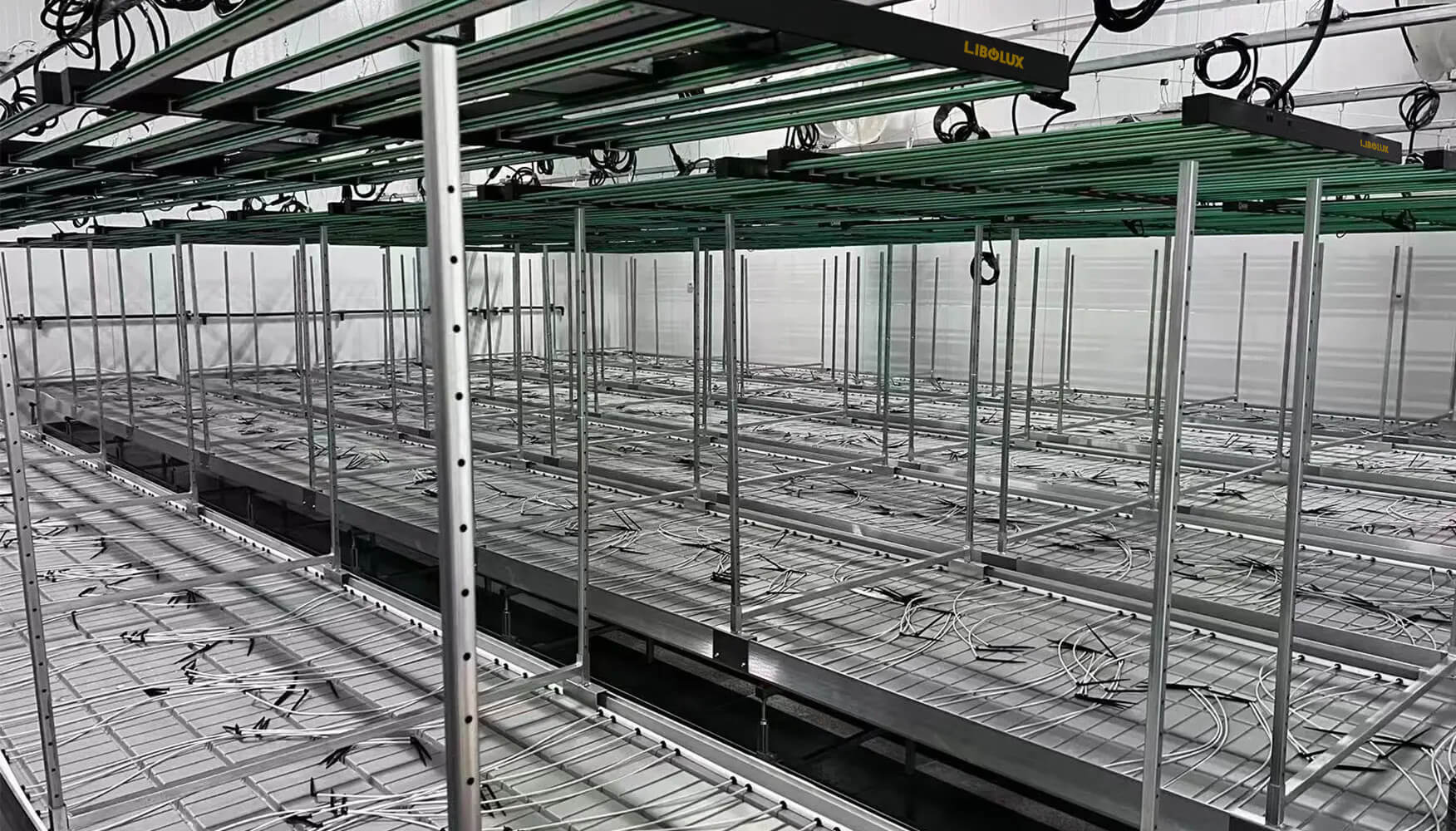
The ranges in this article are worked out with 2.9 µmol/J bar-style fixtures and a 120° beam, which is the range we distribute. Every product sheet publishes PPF, efficacy, dimensions and diode count as a downloadable PDF:
Frequently asked questions
Real questions
-
It depends on the area, not the wattage. A fixture of that order delivers around 1,800 µmol/s: over 1.2 × 1.2 m that averages about 1,250 µmol/m²/s, too much for flowering without CO₂, so either dim it or use it over 2 m². Over 1.5 × 1.5 m, 40–50 cm in flower is a reasonable starting point.
-
Inside a tent with reflective walls, barely at all: the photons bounce and come back to the crop. What it reduces is the intensity peak directly underneath. In an open room with no reflective walls you really do lose light as you raise it, because those photons leave.
-
The signs show up on the plants in the middle and not on the rest: upper leaves curling up into a canoe, bleaching at the tips and stalled growth while the corner plants look normal. If it were a watering or nutrient problem it would hit the whole room evenly.
-
If what you lack is average intensity, more power. If what you lack is intensity in one zone only, move the fixture or split into two units. Lowering the fixture to compensate for an undersized one concentrates light in the middle and leaves the corners just as poor.
-
The target PPFD changes, and the height with it. With CO₂ enrichment it makes sense to work at 900–1,200 µmol/m²/s, which usually means lowering the fixture or using a bigger one. Without CO₂ and climate control, going above 900 is spend without return.
-
The reference stops being height above the plant and becomes spacing between units. As a working rule, the distance between fixture centres should be similar to the height above the canopy: that way the cones overlap and you do not get dark strips between fixtures.
Still running HPS?
Keep reading
If you are coming from sodium, the switch works out in hard numbers: what each one delivers, what you save and how many months it takes to pay back.
Put your own measurements in and stop estimating
The full calculator tells you which fixture fits your area, what average PPFD you will have and what the cycle will cost. With that, height stops being a question.