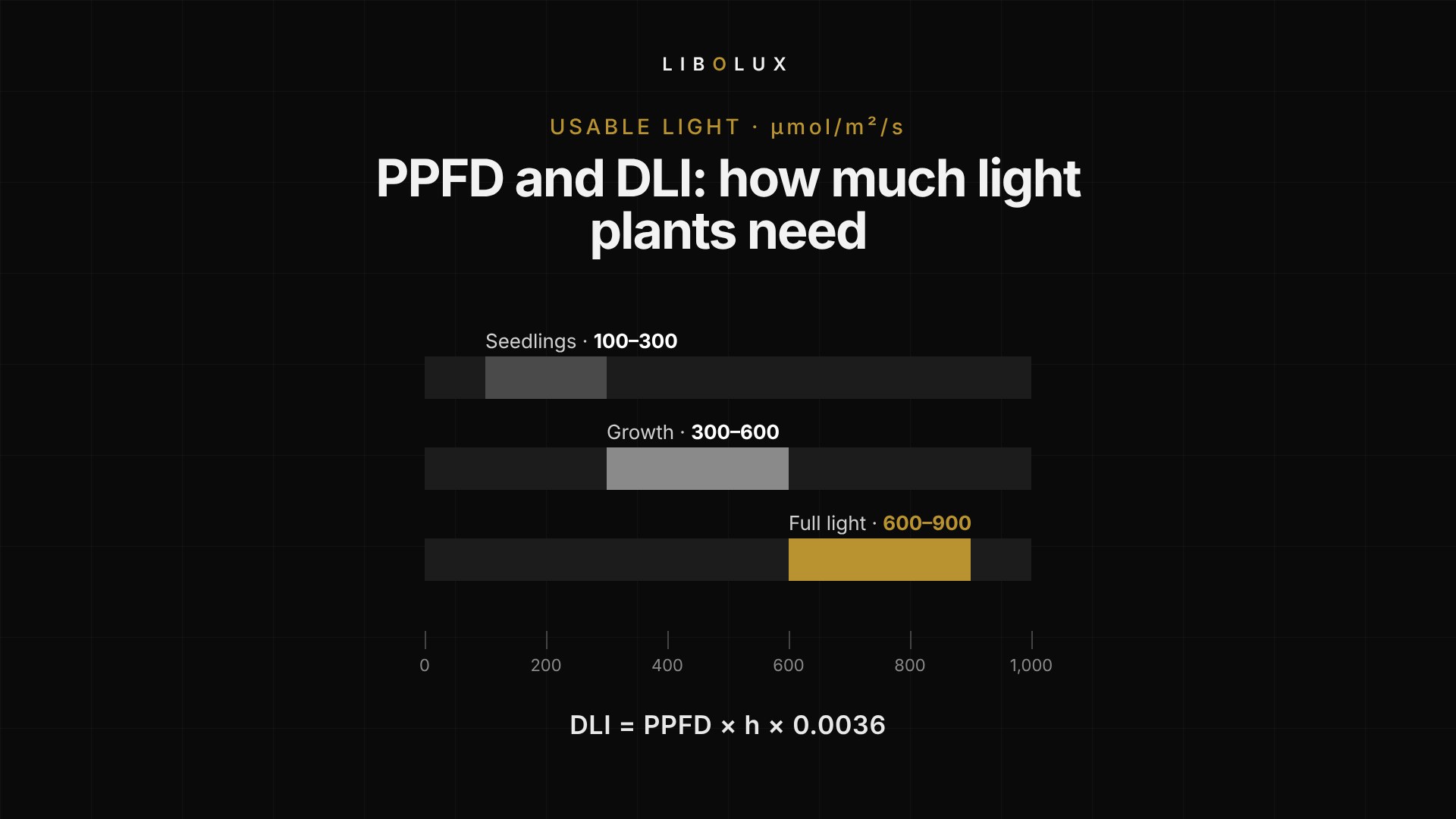
What a plant uses is photons, and the unit that counts them is PPFD: the micromoles of usable light landing on each square metre every second. Quick reference: 100–300 µmol/m²/s for cuttings and seedlings, 300–600 in vegetative growth and 600–900 in flowering without added CO₂.
To pick a fixture, multiply the PPFD you are after by the square metres you want to cover. That gives you the PPF in µmol/s the fixture has to deliver, and a serious spec sheet will list that figure.
Watts measure consumption
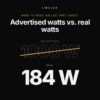
A 600 W rating only tells you that a panel draws more than a 450 W one. How much usable light comes out of that electricity depends on photon efficacy, measured in µmol/J: how many micromoles of usable light come out for every joule going in.
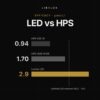
At 2.9 µmol/J, 720 W becomes 2,088 µmol/s. At 2.0 µmol/J the same 720 W would stop at 1,440. You pay the same bill and the crop gets 30 % less light. So the first figures to ask a manufacturer for are measured µmol/s and µmol/J.
The same goes for “equivalent to” claims. If a spec sheet says “equivalent to 1,000 W HPS” and never states the µmol/s, you have no way to check it.
PPFD: the light that reaches the leaf
PPF (photosynthetic photon flux) is what leaves the fixture: µmol/s, a single total. PPFD is what arrives at a given surface: µmol/m²/s. The same panel hung at 30 cm or at 70 cm delivers the same PPF and a completely different PPFD.
That is where the two most expensive indoor mistakes come from. One: too much light too close, and the tips burn. Two: spreading a powerful panel over too large an area and ending up at 250 µmol/m²/s in flowering, which is enough for vegetative growth but falls short in flowering.
Spread is never perfect. The centre of a tent always reads higher than the corners; on a well-designed bar fixture the gap is around 20–30 %. When a calculation says “800 µmol/m²/s”, read it as an average, not as the value at every point.
DLI: a whole day of light in one number
PPFD measures a single moment. DLI (daily light integral) adds up all the light the crop receives in 24 hours and expresses it in mol/m²/day. It is the figure that best explains why two rooms with the same panel perform differently: one runs it 12 hours, the other 18.
DLI = PPFD × light hours × 3,600 ÷ 1,000,000
450 µmol/m²/s for 18 h → 450 × 18 × 3,600 ÷ 1,000,000 = 29.2 mol/m²/day. The same 450 µmol/m²/s at 12 h only reach 19.4.
In practice, in flowering, with the photoperiod fixed at 12 hours, the only way to raise DLI is to raise PPFD. In vegetative growth, with 18 hours available, you can hit a high DLI with noticeably less intensity and less stress on the plant.
How much light each stage asks for
This is the summary we size installations with. The ranges are deliberately conservative, because too much light shows up both on the bill and in the plant.
Light by growth stage
Reference values
| Stage | PPFD | Photoperiod | DLI | What for |
|---|---|---|---|---|
| Cuttings and seedlings | 100 – 300 | 18 h | 13.0 | Rooting and establishment without stressing the leaf |
| Vegetative growth | 300 – 600 | 18 h | 29.2 | Structure, short internodes and broad leaf |
| Flowering without CO₂ | 600 – 900 | 12 h | 32.4 | Production |
| Flowering with CO₂ | 900 – 1,200 | 12 h | 43.2 | Only worth it with enrichment and controlled climate |
PPFD in µmol/m²/s and DLI in mol/m²/day. Switch the photoperiod with the buttons to see how DLI moves at the same intensity.
Above 900–1,000 µmol/m²/s the plant stops responding proportionally unless you add CO₂: you are paying for photons the plant cannot use. Without CO₂ control, 800 µmol/m²/s is a sensible ceiling.
From µmol/s to fixtures
With a target PPFD and your square metres you can do the sum:
Required PPF (µmol/s) = target PPFD × area (m²)
A 1.2 × 1.2 m tent is 1.44 m². Flowering at 800 µmol/m²/s: 800 × 1.44 = 1,152 µmol/s. A 1,160 µmol/s fixture is almost an exact fit.
Put your own measurements in here and we will tell you which fixture fits, what average PPFD you end up with and what the electricity will cost each month:
What each photon costs
Almost nobody publishes how many euros 100 µmol/s cost, and it is the quickest way to compare prices. Divide the price of the fixture by its PPF; it works the same for a 240 W panel as for a 1,000 W one.
The other half of the cost is the electricity bill, which you pay every month. With prices moving the way they do, it is worth doing the sum before you buy:
Five mistakes we keep seeing
- Buying by wattage. It is the one figure that does not describe light. Ask for µmol/s and µmol/J, from a spec sheet with a revision and a date.
- Sizing for the centre. Calculate with the PPFD of the brightest spot and the corners end up at half. Size with the average.
- Ignoring the photoperiod. The same PPFD at 12 h and at 18 h are two different crops. DLI is what rules.
- Pushing intensity without CO₂. Above 900 µmol/m²/s with no enrichment you pay for more electricity without getting more yield.
- Dimming to 50 % “just in case”. A fixture permanently at half power means you bought twice what you needed. Getting the size right is cheaper.
Which fixtures fit each range
Every fixture in our range publishes PPF, efficacy, diode count and dimensions in a PDF spec sheet you can download from the product page. These are the three sizes that cover most rooms:
Frequently asked questions
Real questions
-
PPF is the total light a fixture emits, in µmol/s, and it is a property of the fixture. PPFD is the light arriving at a surface, in µmol/m²/s, and it depends on height, spread and room size. A spec sheet gives you PPF; you work out PPFD with your own square metres.
-
Between 600 and 900 µmol/m²/s without added CO₂. Above that range the plant stops responding proportionally and nearly all of the increase goes into consumption. With CO₂ enrichment it makes sense to go to 900–1,200.
-
DLI = PPFD × light hours × 3,600 ÷ 1,000,000, expressed in mol/m²/day. For example, 600 µmol/m²/s for 12 hours is 25.9 mol/m²/day.
-
For a rough relative idea, yes. For sizing an installation, no. Lux meters are calibrated for the human eye, which is very sensitive to green and poor at deep red, which is the part the plant uses most. A PAR sensor costs more but measures what the plant uses.
-
For the same amount of light, several units spread better and leave fewer shadows, but they add price, wiring and hanging points. In tents up to 1.2 × 1.2 m one well-chosen unit is usually the clean answer; past 2 m² splitting it pays off.
-
Below 2.5 µmol/J the fixture is dated. Between 2.5 and 3.0 is the current quality standard. Above 3.0 you are in the high end. Our Lucius range sits at 2.9 µmol/J and the Libolux TOP panel at 3.3.
So how many fixtures do you actually need?
Keep reading
The next step is turning those µmol/s into specific units for the size of your tent or room.
Size your room with numbers
The full calculator lets you work either by plant count or by floor area, and tells you how many units you need, what they will draw and what the whole cycle will cost.