A 600 W HPS delivers around 870 µmol/s; an LED giving that same light needs about 300 W. The switch is not “a bit better”: it is half the bill for the same number of photons.
The figure that settles the argument is efficacy, in µmol/J. Good HPS tops out at 1.7; poor HPS sits at 0.94. A decent current LED is at 2.5–3.0. Everything else — spectrum, heat, lifespan — comes after that number.
The one figure that compares the two technologies
Comparing HPS with LED by wattage means nothing: the watt measures what you pay, not what the plant receives. The figure that does compare them is photon efficacy in µmol/J — the micromoles of usable light out per joule of electricity in.
And here the numbers are published and measured, not estimated. In the reference measurements by Nelson and Bugbee, a 400 W HPS on a magnetic ballast gives 0.94 µmol/J and a 1,000 W double-ended reaches 1.70, which is the real ceiling of the technology. On the LED side, the DesignLights Consortium has required 1.90 µmol/J as a minimum to certify a horticultural fixture since 2021, and today’s high end passes 3.0.
The ceiling of HPS is the floor of LED
The best HPS made (1.70 µmol/J) does not reach the minimum horticultural certification asks of an LED (1.90). That is not a brand difference: it is a physics difference.
Translated: for the same light on the plant, HPS asks for between 50 % and 100 % more electricity. That is the whole story, and the rest of this article just puts it in euros.
What comes off the bill
Enter the HPS you run, your hours and your real price per kWh. The calculation finds the smallest LED in the range that matches or beats that HPS, and tells you what you stop paying and how many months the fixture takes to pay for itself:
Two caveats so the figure stays honest. First: the payback above counts electricity only. It leaves out bulbs, which in HPS have to be changed every 9–12 months of use because they lose 20–30 % of their output, the ballast, and the cost of extracting the heat. Second: if your HPS is a few years old and has never had a new bulb, it is giving a lot less than the box says, so the real saving will be larger than the calculated one.
Heat: half the problem nobody adds up
A 600 W HPS turns almost everything it does not turn into light into heat. In a closed tent that means a bigger extractor, more noise, more extractor consumption and, in summer, the usual fight to keep the room below 28 °C.
A 300 W LED giving the same light generates roughly half the heat, and spreads it over a large surface instead of concentrating it in one point. That changes three practical things: you can lower the fixture without burning, the extractor works less and in summer the room is governable.
There is an honest point against it: in winter and in cold rooms, HPS heat was free heating. Switching to LED, there are garage and uninsulated-warehouse grows where the temperature drops further than it should and has to be made up. That is not a reason to keep HPS, but it is worth planning for.
Spectrum: where HPS really loses
High pressure sodium emits almost everything in the yellow-orange, with very little blue and little deep red. It works — people grew with it for forty years — but it forces you to run one single light recipe for the whole cycle.
A full-spectrum LED with high-efficacy white diodes covers the photosynthetic range continuously and allows two things HPS does not: seeing the plant’s real colour (a nitrogen deficiency under HPS is caught late, because everything looks yellow) and adjusting intensity without changing the spectrum.
What you should not buy is the “magic spectrum” story. Purple panels of pure blue and red diodes were an attempt to save watts back when whites were expensive; today a good white gives more usable photons per joule and lets you see the crop. If a spec sheet boasts about spectrum but does not publish µmol/J, it is selling the colour, not the light.
Lifespan and what each one costs to keep running
- HPS bulb: replace every 9–12 months of use. It does not blow, it fades continuously: at 12 months it can be down to 70–80 % of its original output with nothing visible to the eye.
- Ballast: magnetic ones draw an extra 10–15 % that never becomes light, and they hum. Electronic ones half-fix that, but they are one more component that fails.
- LED diode: the reference is L90, the hours until output falls to 90 % of initial. In the range we distribute that is over 50,000 hours, which at 12 h/day is about eleven years.
- Driver: this is the part that really sets the life of the fixture. Panels with an internal replaceable driver let you swap it without binning the whole thing; worth asking before you buy.
When HPS still makes sense
Saying LED always wins would be selling, not informing. There are three cases where HPS is still defensible:
- It is already paid off and you grow little. If you run two months a year, the annual saving is small and payback stretches to several years. Run it until it dies.
- You need the heat. Cold greenhouse or uninsulated warehouse in winter: HPS does two jobs and the sums change.
- Very tight budget today. A complete HPS kit costs considerably less up front. That is a cash decision, not a technical one: you will pay the difference on the bill, but you will pay it spread out.
Outside those three, the sums do not work. And if you run all year, they do not work by a wide margin:
What to ask of an LED before switching
If you decide to make the jump, the risk is no longer HPS: it is buying a bad LED and concluding that “LED does not work”. Four figures that have to be on the spec sheet, with a revision and a date:
- PPF in µmol/s measured in an integrating sphere, not “equivalent to X watts of HPS”.
- Efficacy in µmol/J. Below 2.5 is old technology. 2.5–3.0 is today’s standard. Above 3.0, high end.
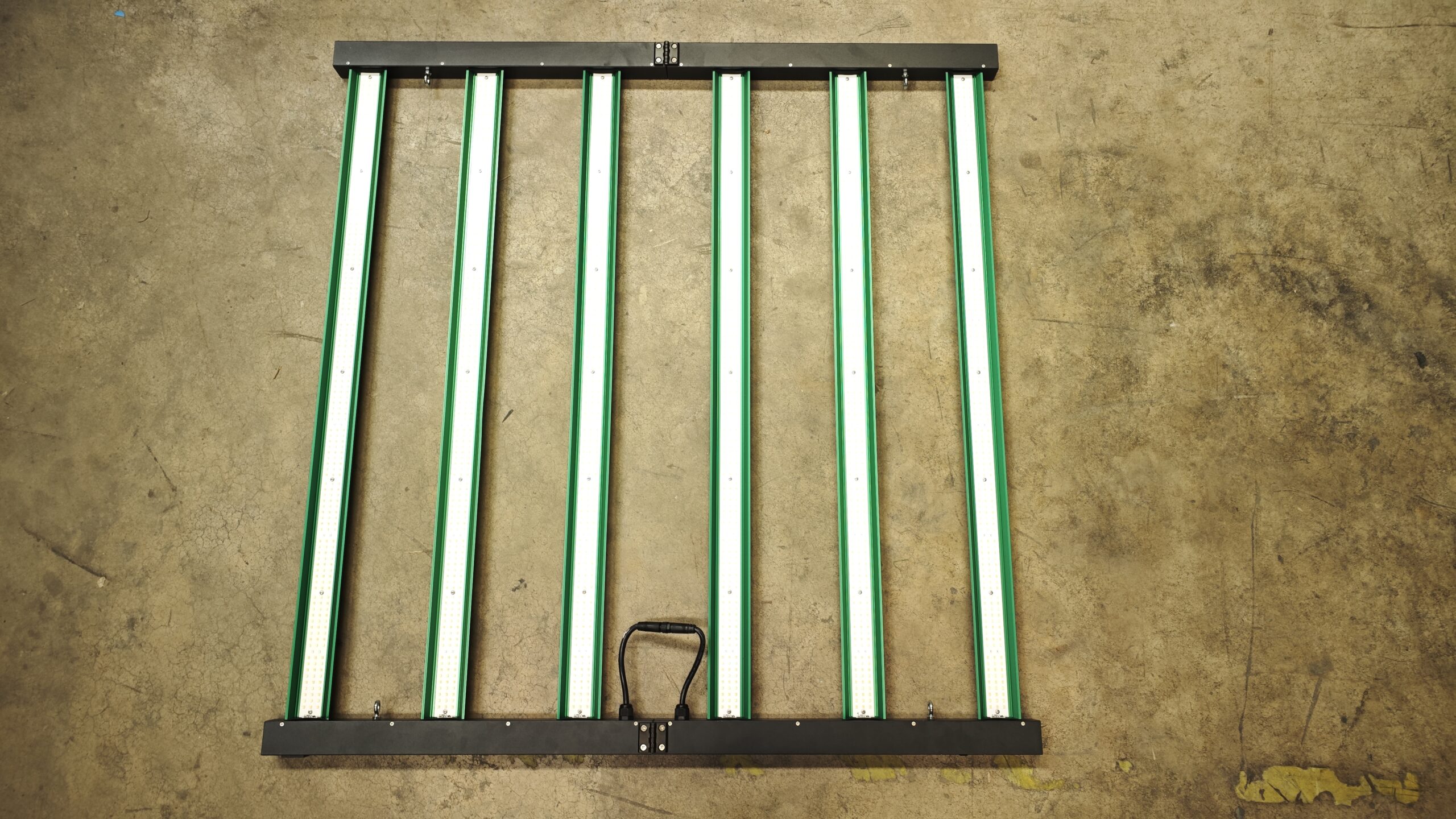
- Dimensions and diode count. A bar fixture spreads better than a compact board of the same power.
- Voltage and current range. If it is missing, the sheet is incomplete.
And then the figure that really compares catalogues: euros per 100 µmol/s. It sorts the market in thirty seconds:
Which fixture replaces which HPS
As a quick reference: a 400 W HPS is covered by about 240 W of LED, a 600 W by about 300–400 W and a 1,000 W double-ended by about 630–720 W. These are the three sizes most often asked for as replacements:
Frequently asked questions
Real questions
-
About 300 W if the LED runs at 2.9 µmol/J. The sum is direct: a 600 W HPS at 1.45 µmol/J delivers around 870 µmol/s, and 870 ÷ 2.9 is 300 W. Be wary of “equivalences” that never show this working.
-
On the fixture’s electricity, yes, at those efficacies. And a bit more once you count the extractor working less with less heat. What you should not expect is the yield to rise on its own: if you keep the same PPFD, what changes is consumption, not production.
-
At the same PPFD on the canopy and the same climate, no. The idea comes from the first cheap LEDs, which delivered far less light than they claimed. Compare by real µmol/m²/s rather than by watts and the result is equivalent or better.
-
Every 9–12 months of continuous use. It does not blow: it loses output gradually, and it is very common to keep running a bulb that is already down to 70 % without noticing, because the eye does not register the drop.
-
It depends how many hours you run. At 12 h/day all year, payback usually lands under a year and after that it is clean saving. With short seasonal use the sums stretch and waiting makes sense.
-
They were a solution for their time, when an efficient white diode was expensive. Today a good white gives more usable photons per joule and lets you see the plant’s real colour to catch deficiencies. Spectrum does not make up for low efficacy.
And how high do you hang it?
Keep reading
Changing technology changes the mounting too: an LED allows different distances and spreads light differently.
Run the numbers with your own figures
The full calculator starts from your area and your kWh price, and tells you which fixture fits, what PPFD you will get and what the whole cycle costs.